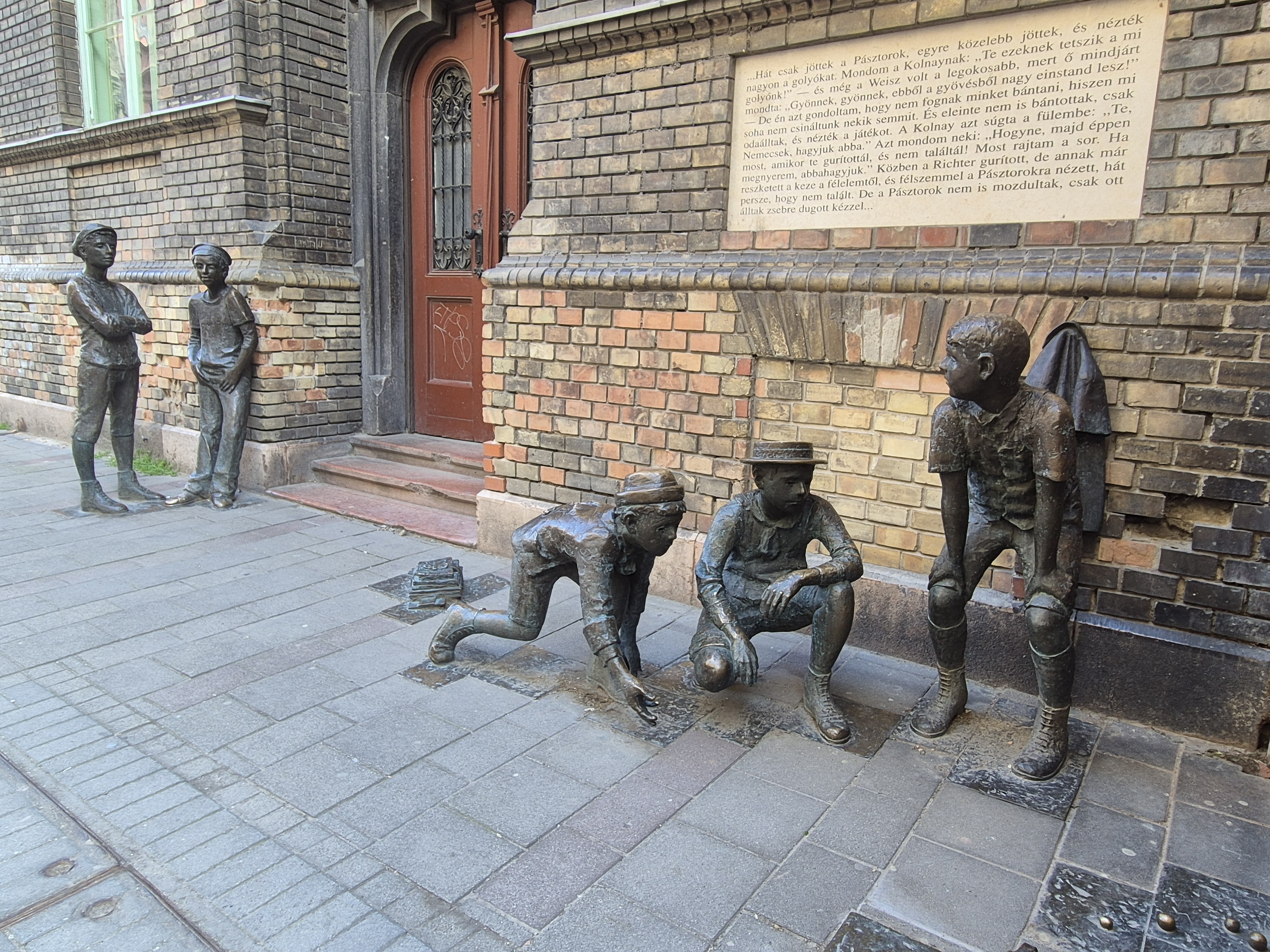
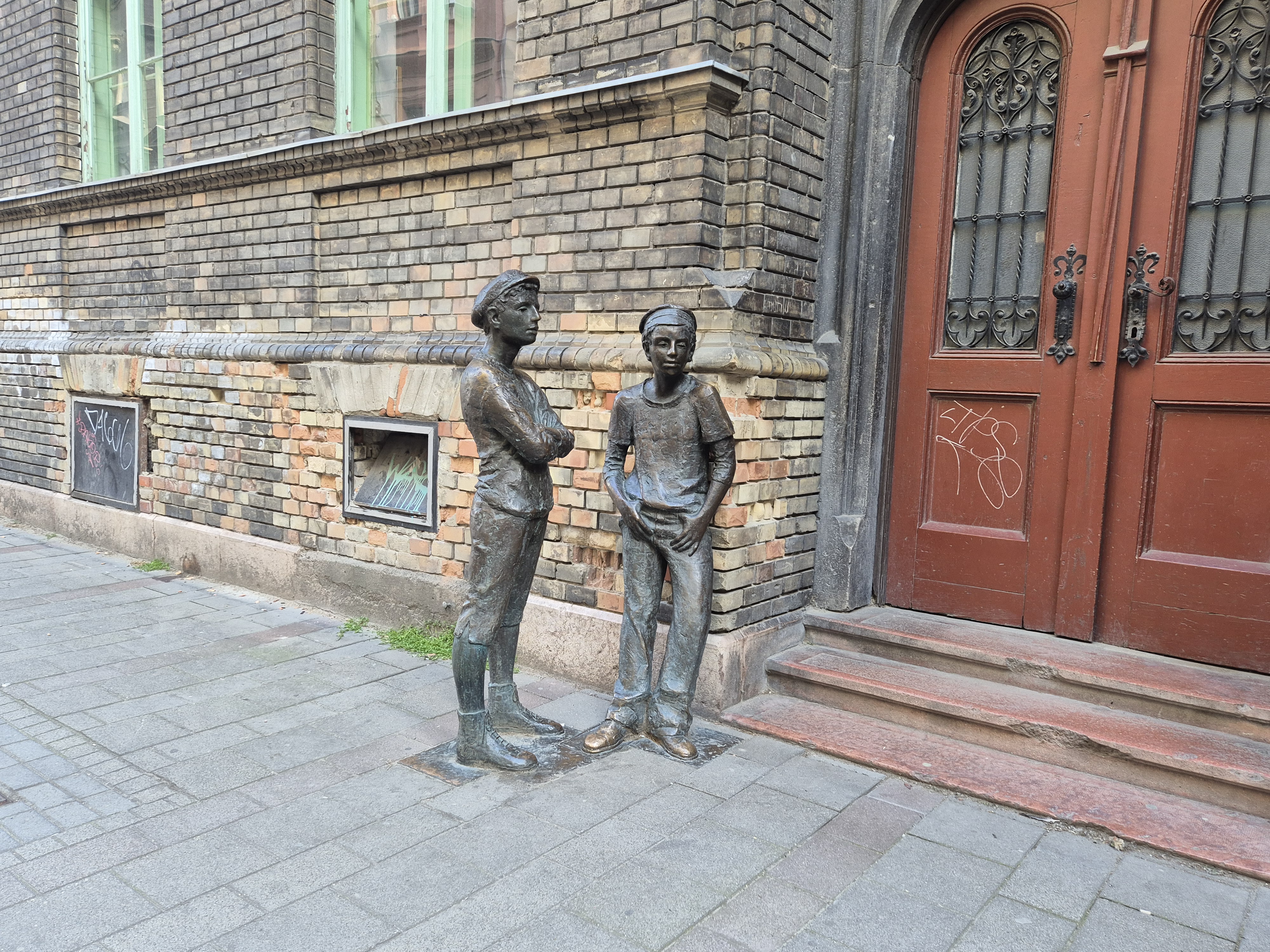
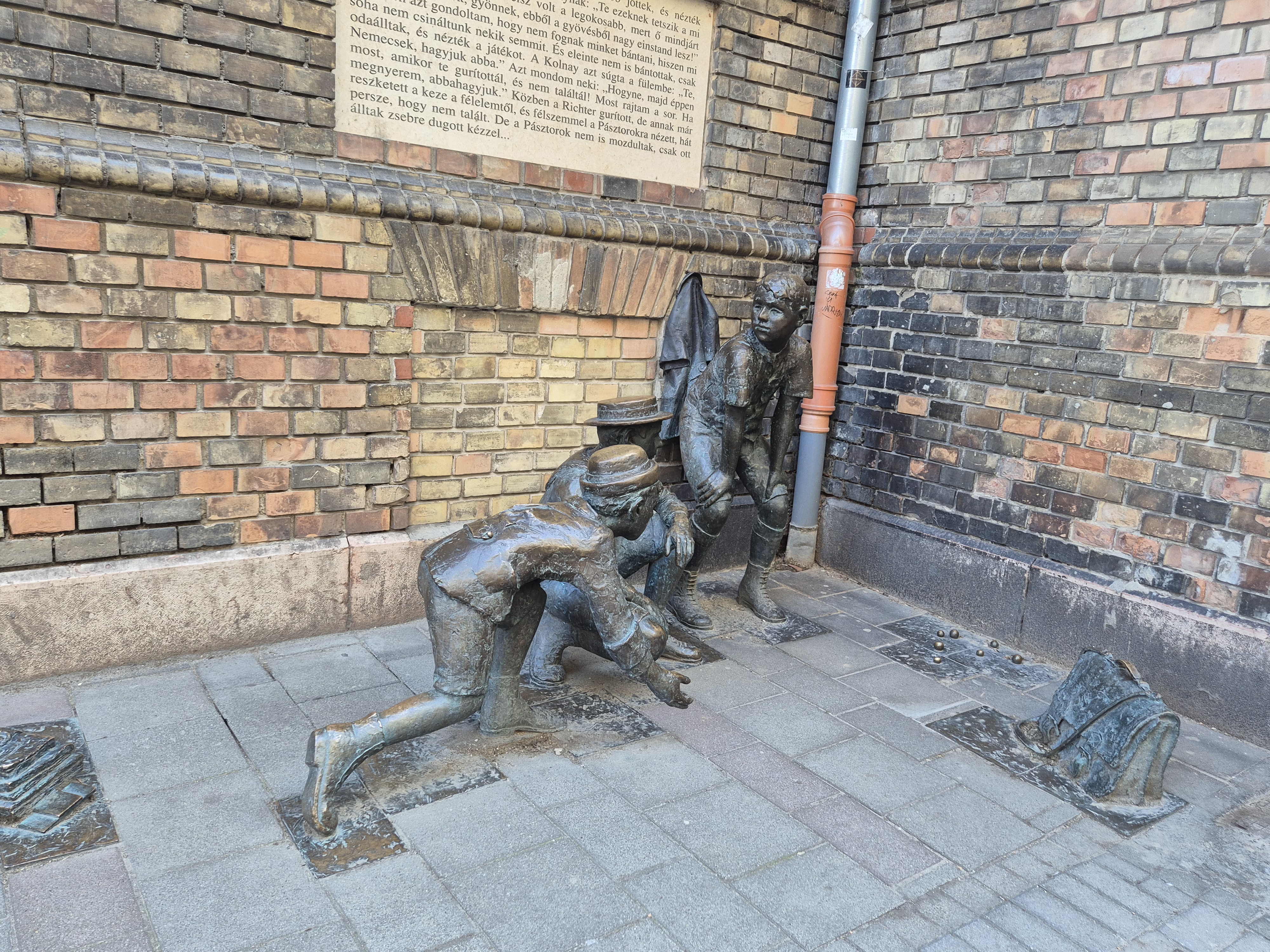
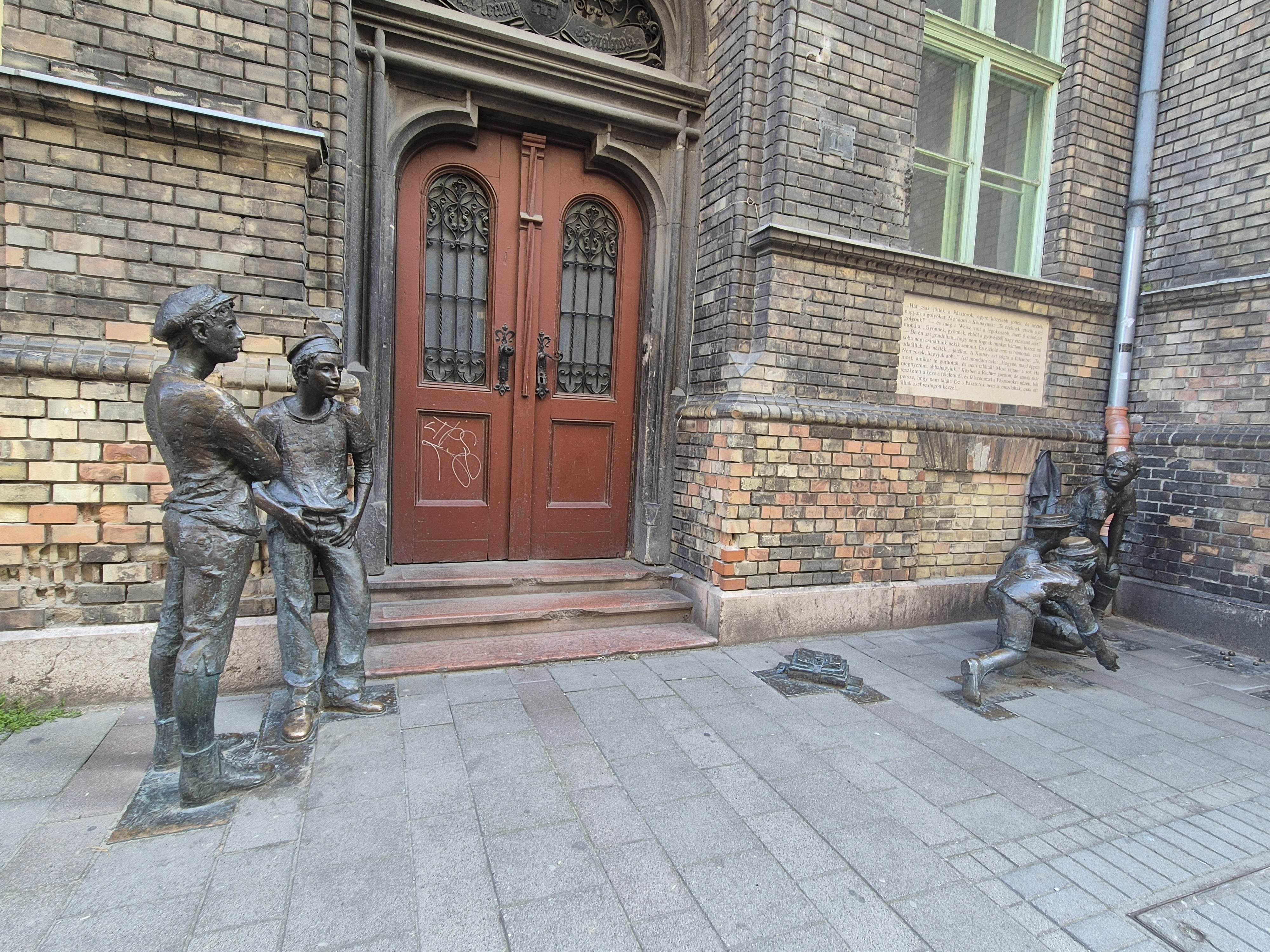
Statue of The Paul Street Boys
This public artwork, located at 11 Práter Street in Budapest's 8th district, depicts one of the most defining scenes, the 'einstand', from Ferenc Molnár's 1907 novel, The Paul Street Boys. The sculpture group was created by sculptor Péter Szanyi and was unveiled in September 2007 to mark the 100th anniversary of the novel's publication.
- Paid parking available
The Life and Work of Ferenc Molnár
Ferenc Molnár (1878–1952) was one of the most acclaimed Hungarian playwrights, journalists, and novelists of the 20th century, who gained international fame. Born into a middle-class family in Budapest, he studied law but soon turned to journalism and literature. His works are characterised by sharp social critique, accurate depictions of bourgeois life in Budapest, excellent dialogue, and subtle humour. His most famous play, Liliom, achieved great success abroad and served as the basis for the Broadway musical Carousel. During the First World War, he worked as a war correspondent, and in the late 1930s, he emigrated to the United States to escape fascism, passing away in New York.
The Plot and Themes of The Paul Street Boys
Published in 1907, the novel is set in turn-of-the-century Budapest, in the Józsefváros district, and portrays a territorial battle between two groups of boys: the Paul Street Boys and the Redshirts. The stake is the 'grund', a vacant plot next to a lumberyard, which represents freedom and play for the Paul Street Boys, while the Redshirts want it as a place to play ball. The central figure of the story is Ernő Nemecsek, the only private among the Paul Street Boys, a small, blonde, frail boy often overlooked by his peers but who demonstrates the greatest courage and loyalty.
The plot unfolds through the groups' manoeuvres, secret reconnaissance missions to the Redshirts' base (the Botanical Garden), and betrayals, leading to the final open battle. During the missions, Nemecsek is repeatedly forced to wade into cold water, which results in severe pneumonia. On the day of the decisive battle, he rises from his sickbed to return to the 'grund' and, with his last strength, overpowers the Redshirts' leader, Feri Áts, thus deciding the war. Nemecsek dies shortly afterwards, and the victorious Paul Street Boys learn from an engineer that the 'grund' is to be built over with a large apartment block, rendering their sacrifice entirely futile. The novel is a universal symbol of friendship, self-sacrifice, patriotism, and the often painful process of growing up.
About the Statue
The statues are located in front of the wall of the Práter Primary School building, directly at street level, without a pedestal. The composition consists of five figures: three smaller boys (including Ernő Nemecsek) playing marbles on the ground, while the two older brothers, the Redshirt Pásztor brothers, loom threateningly over them to take their toys. Water flows artificially from the architectural background formed by the school wall, evoking the atmosphere of rainwater drains on Budapest apartment buildings.
- Editorial Content -
Target group
-
Class trips
-
Families with younger children
-
Families with older children
-
Multigenerational programs
-
Friends
-
Seniors
-
Couples
Other services
Sights, programs
All
Parking information
- Paid parking available