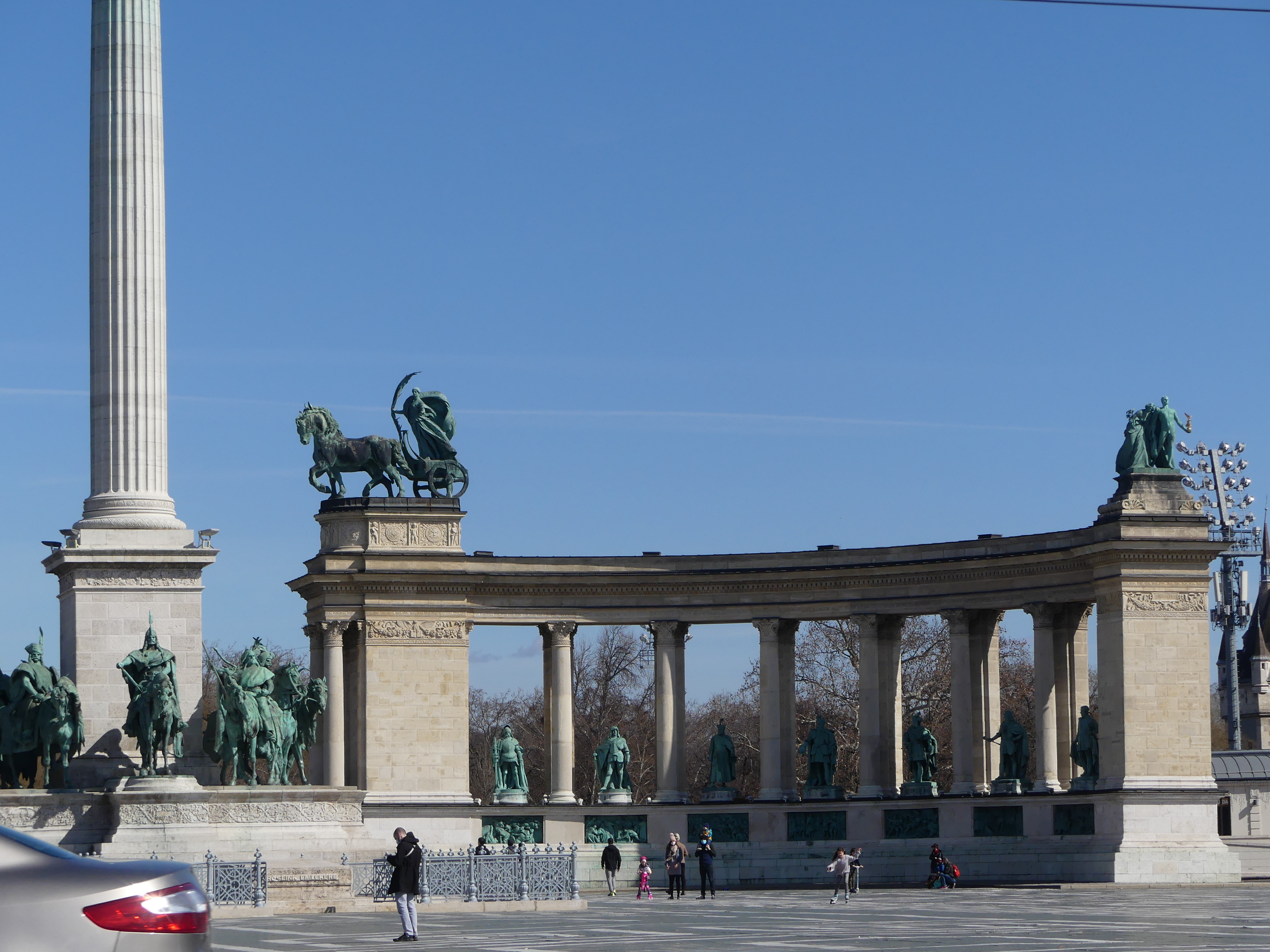


Heroes' Square
Heroes' Square is one of Budapest's most famous and most visited public spaces, marking the end of Andrássy Avenue and serving as the gateway to City Park. Together with the Millennium Monument, the square is one of the most important symbols of Hungarian statehood and historical memory in Budapest, and along with Andrássy Avenue, it is part of the Budapest World Heritage Site.
- Electric car charging
- Paid parking available
- Electric car charging available (paid)
History
The square began to take its current shape during the 1896 Millennium celebrations, as part of major urban development projects in Budapest to mark the thousandth anniversary of the Hungarian Conquest. The statue complex and the final layout of the square were completed by 1929 after subsequent modifications, making Heroes' Square not the creation of a single era but a meeting point of multiple historical layers. In 1989, it was the site of the reburial of Imre Nagy, giving it a prominent place in the memory of modern Hungarian history.

Significance
The greatest value of Heroes' Square is its ability to narrate Hungary's history in a way that is both accessible and monumental. The central monument's column and the surrounding statues depict the seven chieftains of the Hungarian Conquest, Saint Stephen, and other significant rulers and statesmen who played key roles in shaping the Hungarian state and culture. The Heroes' Memorial Stone embedded in the square's pavement honours those who died heroically, making the location a blend of artwork, national memorial, and urban landmark.

What to See Here
The experience of the square is not just about the statue complex itself but also its immediate surroundings. Heroes' Square is flanked by the Museum of Fine Arts and the Kunsthalle, and just a few steps away are more cultural and recreational venues in City Park. This makes the square an ideal starting point for visitors who want to combine history, art, and green spaces in a single city walk.

Role in Sustainable Tourism
Heroes' Square is important for sustainable urban tourism because it condenses significant cultural values into an area that is easily walkable and well-connected by public transport. It is directly linked to the Millennium Underground Railway (M1), built beneath Andrássy Avenue, which, as the continent's first underground railway, still plays a key role in accessing the area. The World Heritage status reinforces a preservation-focused approach, while the renewal of the City Park area has replaced large parking lots with new walkways and green spaces, supporting a more human-centred, less car-dependent visitor experience. Thus, Heroes' Square is not only an iconic photo spot but also a prime example of Budapest tourism built on cultural heritage, public transport, and quality public spaces.
- Editorial Content -
Target group
-
Class trips
-
Families with younger children
-
Families with older children
-
Multigenerational programs
-
Friends
-
Seniors
-
Couples
Other services
Sights, programs
All
Parking information
- Paid parking available
- Electric car charging available (paid)